That question lands on my desk in some form almost every time I sit down with a seller. Should I fix my house before selling it, or list it and let the buyer deal with whatever needs work? And I get why it feels urgent. You’re about to put your house in front of strangers who are going to judge it, compare it to everything else on the market, and offer you less than you want if they find reasons to. The instinct to fix things first makes complete sense.
The problem is the question itself. “Should I fix my house before selling?” pushes sellers toward a binary choice: renovate everything, or sell it as-is and take the hit. The real decision is more surgical than that.
The question worth asking is which specific conditions will materially affect how buyers perceive this property, and which expenditures this market is unlikely to reward. Sellers who answer both of those before they call a contractor tend to come out ahead of sellers who just start fixing things.
Why the binary thinking happens
I understand the impulse to renovate everything. It feels like control. If the house is in perfect shape, no one can criticize it. No one can use condition to negotiate you down. You go to market on offense instead of defense.
I also understand the opposite instinct: skip preparation entirely, price accordingly, and let a buyer handle whatever needs handling. That one feels honest. Maybe even liberating.
Both of those mindsets are responding to fear more than evidence. The seller who renovates everything is afraid of buyer objections. The seller who lists as-is is afraid of spending money without knowing what it will return. Both fears are legitimate. Neither one, on its own, produces a reliable strategy.
What produces a reliable strategy is walking through the specific property, identifying what’s actually going on with it, and making a deliberate decision about each item based on what buyers in this market are likely to care about.
Old is not the same as defective
This is probably the most useful distinction I make in pre-listing conversations, and it’s the one that saves sellers the most money.
A house that hasn’t been remodeled in fifteen years is not a broken house. It’s a house with dated finishes. Buyers understand what they’re purchasing when they buy a home in a neighborhood where prices reflect that vintage. They’re not expecting a new kitchen. They’re expecting a functional, maintained home in the price range they can afford.
What they’re not expecting is visible evidence that the house has been neglected or left unfinished. That’s what changes their behavior.
There’s a practical difference between a bathroom vanity that’s fifteen years old and a bathroom faucet being operated with vice grips because the handle is gone. Both are imperfect. Only one of them makes a buyer wonder what else the owner stopped taking care of.
I walked through a house in New Haven recently that illustrated this in almost every room. Older HVAC equipment, but functioning with no documented problems. Serviceable appliances, one of which had been temporarily stored in the garage and needed to be cleaned and reinstalled. A refrigerator with some dents. None of that required replacement. Clean it, reinstall it, document that the mechanical components have been maintained, and present the house as cared for. That’s a completely different economic calculation than ripping out an air handler because it’s not new.
The age of a component is not, by itself, justification for replacing it. Whether the component functions, whether its condition is visible to buyers, and whether its appearance suggests neglect: those are the questions.
Finishing versus renovating
The second distinction I make in almost every walkthrough is between finishing and renovating.
Renovation means changing what’s there. Finishing means completing what’s already underway, or correcting what looks visibly incomplete.
Open drywall is a finishing problem. The same house in New Haven had a section of dining-area wall that had been opened for plumbing work and not yet closed and finished. That’s not a renovation. It’s drywall and joint compound. But to a buyer walking through, an open wall says the project isn’t done. And if that project isn’t done, what else isn’t?
The same principle applies to flooring, trim, paint, and fixtures. Cracked floor tiles don’t just look bad in isolation. They make buyers wonder whether the whole floor is failing, whether there’s a substrate problem underneath, whether they’re buying a house that’s going to need a full flooring replacement in six months. The actual scope of the problem may be six tiles and some deteriorated grout. The buyer’s imagination is more expensive than that.
In the New Haven house, several ceramic tiles were cracked and the grout throughout had deteriorated and discolored. The initial approach was to locate a close replacement tile and do selective repair rather than tear out a floor that was otherwise serviceable. Most of this floor is fine, so let’s fix what isn’t. The sellers ultimately couldn’t source a close enough match and shifted to a flooring replacement approach. That was the right call given the constraint. The starting question was still the right one: do we have to replace all of it?
When buyer anxiety is the real problem
Some conditions don’t point to an obvious structural defect, but they create concern disproportionate to what’s actually going on.
The New Haven house had a front porch where one slab section had visibly settled. There was separation visible where the support post and trim met the porch roof. The working field read was that the porch slab and the house foundation were separate structures, and no evidence was presented that the house foundation itself had any problem. But that visible separation, a post that looks like it may have shifted, is exactly the kind of thing a buyer photographs and sends to their contractor before making an offer. Whether or not there’s a real structural issue underneath it, the appearance of one is enough to suppress buyer competition or hand someone a negotiating point they’ll use aggressively.
That made it worth addressing before listing. Not because the house was unsafe. Because perception is part of the product.
That’s a harder conversation to have with sellers, because it’s not about fixing something broken. It’s about removing a question from a buyer’s mind before that buyer ever walks through the door. But it makes sense when you hear it: the goal isn’t to present a perfect house. It’s to present a house that doesn’t give buyers reasons to walk away or negotiate hard.
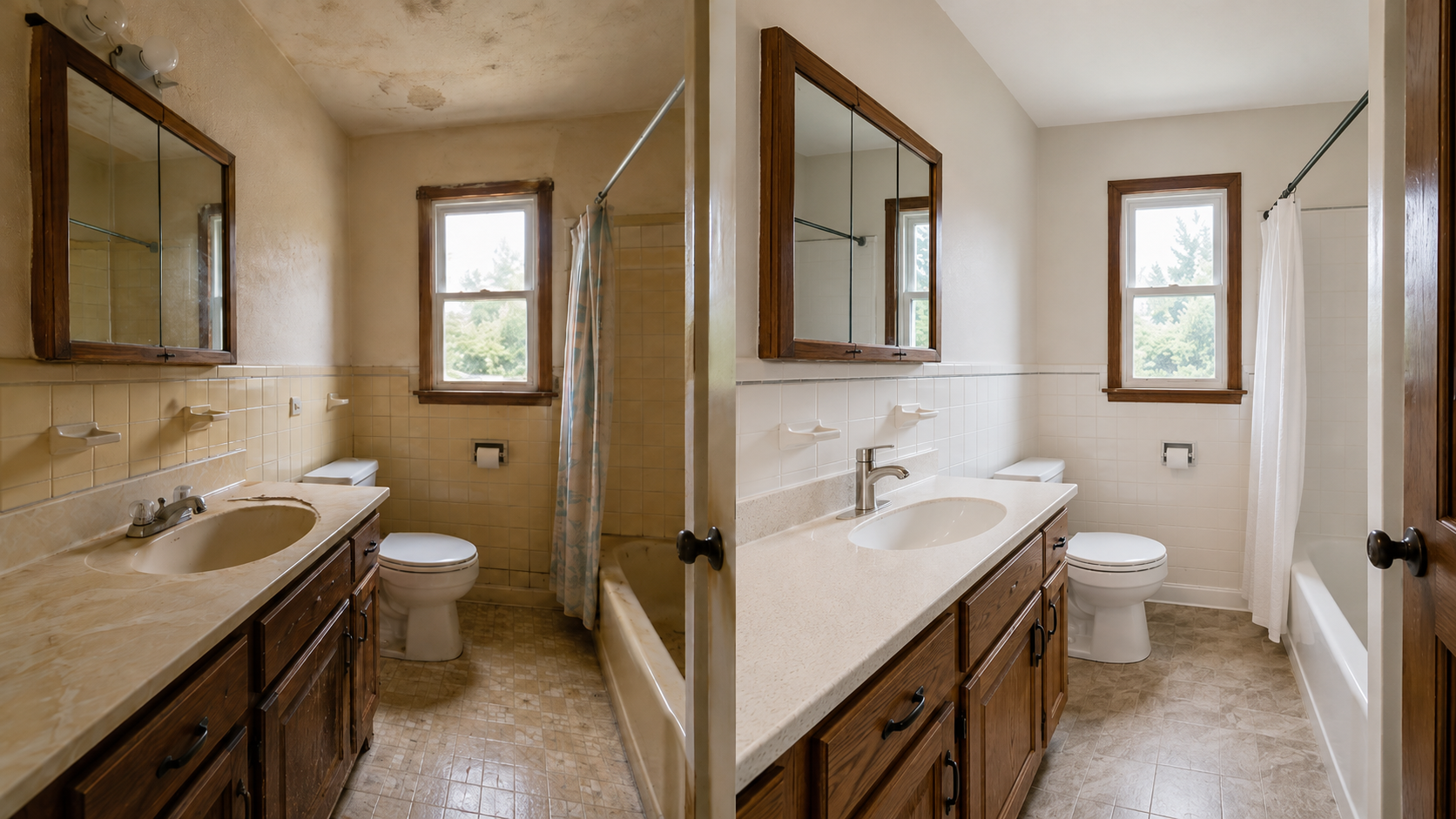
The bathroom in that same house had a cracked sink and a faucet handle that had been replaced with vice grips at some point. The ceiling had some moisture-related paint issues from inadequate ventilation. The vanity cabinetry showed wear. The sellers’ work ultimately included new sinks, new faucets, new plumbing under the vanity, and framing added around the bathroom mirror, along with ceiling and paint work. They restored the existing vanity rather than replacing it. Fix what’s broken, finish what’s incomplete, clean and restore what’s serviceable. Don’t gut a bathroom because it’s dated.
The market sets the ceiling
Here’s the economic reality that shapes every pre-listing preparation decision: the surrounding market puts a practical ceiling on how much preparation spending the sale can absorb.
Buyers compare. They can see everything else available in a neighborhood for the same price. If comparable homes in a given area are selling in a certain range, a renovation that pushes the list price significantly above that range isn’t going to be rewarded, regardless of how nice the work is. The money spent above what the market supports doesn’t come back at closing.
In New Haven, recent 2026 sales in the immediate area ranged from the low $210s to the low $240s depending on size, condition, and finish level. That context shapes the preparation strategy. The goal is to present a finished, credible home that competes confidently within that range, not to build a home the neighborhood can’t support.
The prior transaction on this property had produced an FHA appraisal of $208,000, with a condition rating that noted deferred maintenance. Newer comparable-market evidence developed during the preparation period has given me more confidence in a higher list price once the work is complete. That confidence reflects both what the sellers have done to the property and what the market has continued to demonstrate. Preparation improves the product. The market determines what the product is worth.
Understanding what your home is actually worth in Fort Wayne before you start writing checks is the right starting point for this conversation. That number, grounded in actual comparable sales rather than automated estimates, is what tells you how much room you have to work with.
It’s also worth knowing what it actually costs to sell a house in Indiana before you add a preparation budget on top of closing costs, agent compensation, and everything else that comes out at the table. The full picture of what you’re spending and what you’re likely to net should be visible before any preparation decisions are finalized.
And if you’re wondering about timing, the Fort Wayne market has shifted in ways that affect how buyers are behaving right now, which matters when you’re deciding how much preparation leverage you actually have.
Don’t list while the work is still happening
One of the more consistent pieces of advice I give sellers is to resist the temptation to list before the preparation is finished.
I understand why the temptation exists. The house is mostly ready. You’re eager to get on the market. You figure serious buyers can see past an unfinished room or a floor that hasn’t been installed yet.
That’s usually not how it plays out.
Listing photos are permanent. Every buyer who searches for your property over its entire time on market is going to see those photos. Open drywall, unfinished flooring, or a room that’s obviously mid-project tells every one of those buyers that the house wasn’t ready when it went live. Days on market start the moment the listing is active. If the house sits while visible work continues, you’re accumulating a market history that buyers and their agents will notice and use.
Finish the preparation. Schedule professional photography once the work is complete. Enter the market with a product that looks finished because it is. Patience before photography protects the first impression that determines a lot of what happens next.
The conversation worth having first
Should you fix your house before selling it? The honest answer depends entirely on what’s actually going on with the property and what the surrounding market is realistically capable of rewarding. That’s not a question you can answer from a generic checklist. It’s a conversation.
Sometimes sellers are about to spend significant money on things that won’t change what a buyer offers. Sometimes the as-is value is close enough to the prepared value that a completely different strategy makes more sense. Sometimes the right move is targeted preparation that gets the house to a price point the market genuinely supports, without spending a dollar more than necessary to get there.
That conversation costs you nothing. The mistakes it prevents often cost a lot more.
Call me at 260-305-8804 or reach out through davidbarlag.com. Before you spend anything, let’s figure out what actually matters for your specific house.